Suppose you go to work one day in the morning and you hear that your salary is at stake not due to your performance, but due to some machine that you never operated.
That is what has happened to thousands of MCD workers currently.
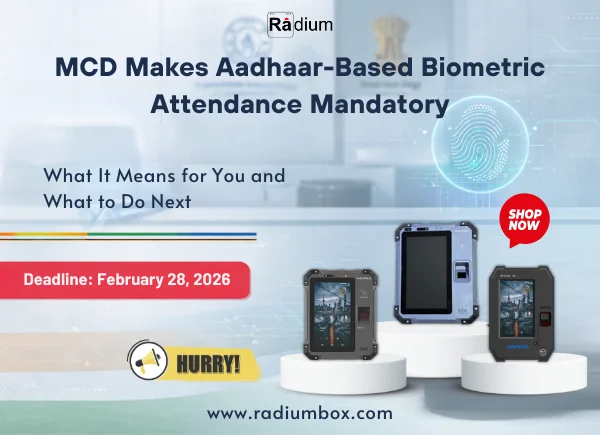
It is an official requirement of Municipal Corporation of Delhi (MCD) that all the personnel posted at headquarters are required to register themselves by MCD attendance system Aadhaar-Based Biometric Attendance System (AEBAS). And the deadline? February 28, 2026. Missing it might result in a loss of pay.
I know that sounds stressful. However, here is the point it does not need to be. Be it an MCD official, attempting to know the new system, an HR manager, attempting to figure out how to get your team on board, a procurement officer, attempting to find the right Mantra AEBAS device, then consider this post to be your hook-up.
In early 2025, MCD published a circular that would have registered AEBAS as mandatory to all employees at its headquarters. The key points are:
Every official has to be enrolled in Aadhaar-Based Biometric Attendance System.
The processing of Group C and Group D staff salary has been made directly dependent on the attendance on AEBAS.
Registration deadline is already set to February 28 - there is no mention of extensions.
Those employees who fail to meet the deadline risk losing their salaries.
The officials of MCD explained this move is to enhance transparency, administrative discipline, and simplify the process of tracking attendance in the organization.
That is why, a lot of employees today have a face recognition system which is based on location. In the future, the Aadhaar biometric attendance platform based on Aadhaar is the main and obligatory one.
You may be asking yourself - why trouble something that appears to be functioning?
This is the straight forward answer: as much as location-based attendance systems are convenient, they are not without known loopholes. Individuals are able to check into work remotely, can falsify GPS records or may choose to have a workmate take their place. It is referred to as buddy punching and it is a fact that it is a serious issue in big government agencies.
Biometric attendance machine is different at Aadhaar. It links attendance with a biometric identity of an individual, that is, with a fingerprint of an individual or an iris scan, which is checked against the UIDAI (Unique Identification Authority of India) database. You must literally be present. No proxies, no workarounds.
That is of concern in a civic body such as MCD which deals with thousands of employees in the city of Delhi. It eliminates the ghost employees, equitably processes payrolls, and establishes trust in the society.
I will explain to you in plain words.
The Aadhaar number of the employee is first registered in the AEBAS portal. This is a one-time process.
The employee scans his or her finger (or eyes into an iris scanner) on the Mantra AEBAS biometric device. The device records the biometric information and transmits it to the UIDAI servers where it is authenticated in real-time.
After UIDAI verifies the identity, the attendance is automatically recorded to the central AEBAS portal. All the recorded information is the time of the act, the place and the employee name.
Attendance data is drawn out of AEBAS via HR and payroll systems. No attendance record = no salary. Easy, open and difficult to cheat.
This is what many are confused about. All biometric devices are not compatible with AEBAS. One should have a certified and STQC-approved device that can be connected to the NIC (National Informatics Centre) AEBAS platform.
When it comes to the AEBAS devices that are known to be reliable and the ones that have been certified by the government, it has been one of the most dependable names in this field. These are three of their best products that one should know about:
🔷 Mantra L1 MBAS — Aadhaar Enabled Biometric Attendance System —It is a flagship biometric attendance system of fingerprint that is certified by the AEBAS. It is specially targeted at government attendance applications, and it has a powerful fingerprint sensor, STQC certification, and smooth connections to NIC AEBAS portal. India government infrastructure based, fast and reliable.
🔷 Mantra MFSTAB — Embedded Advanced AEBAS — The MFSTAB will be a step up - a smart tab-like device that has embedded AEBAS capability. It has the capability of a fingerprint scanner and a built-in display, which makes it a good fit in any department that does not need a separate computer or a display to use it.
🔷 Mantra MBAS20i — Next-Gen AEBAS Device — This is one of the most sophisticated AEBAS devices offered by Mantra. It has better fingerprint detection, higher authentication rates, and a stylish look, and it would best suit well in high-traffic places such as big government offices or headquarters - just the type of solution MCD will be seeking to implement.Government offices or headquarters — exactly the kind of setup MCD needs.
All three devices are designed to be compatible with the official NIC AEBAS infrastructure, which implies that they can be used by companies that require quickly complying.
In case you are employed in MCD headquarters and have not yet registered in AEBAS, it can be done as follows:
Get in touch with the nodal officer of your department or your HR representative.
Bring your Aadhaar card (or bear your Aadhaar number).
Visit the biometric enrollment station of MCD.
To scan your finger, you have to put it on the scanner, and your biometric information will be recorded and associated with your Aadhaar.
Make sure that your registration is listed in the AEBAS portal.
Don't wait. The deadline of February 28, 2026 is strict and the clause of salary withholding is a reality. An hour of work to-day will save you a month of pay-roll headaches.
A realistic checklist would be as follows in the case your task is to implement AEBAS to your office:
Determine the number of employees that should be enrolled, and the number of devices you will require.
Select registered AEBAS equipment - seek out STQC and NIC AEBAS conformity. MBAS line of Mantra is a good beginning.
Install point of devices on entry / exit points.
Ask your IT department to connect the devices to the NIC AEBAS portal.
Educate the staff on the utilization of the machine - they are glad and easily trained, but a 5-minute tutorial can work wonder.
Develop a registration drive with definite time limit and make known to every employee.
Oversee the enrolment progress and chase up the stragglers on a day-in day-out basis.
The positive thing is that with the right hardware in place, the technical side of AEBAS is relatively easy. Change management is the more difficult one - to make employees realize why it is important and make the process of enrolling to the program simple enough so that they could enjoy it.
Yes. Your complete biometric data is not stored on the device by the AEBAS platform. The process of authentication occurs in real time, with the UIDAI server and only yes/no response is sent back. UIIDA retains your biometric template.
This occurs now and then or to employees who engage in manual labor and whose fingerprints have been worn out. In this scenario, iris scanning is also supported by the majority of AEBAS-compliant devices as an alternative. The mantra devices, e.g., exist in multi-modes.
Majority of the current AEBAS devices are capable of storing attendance information locally and synchronizing it once connected. With that said, it is worth verifying this functionality with your vendor of the device prior to deployment.
Every citizen of the Indian nation is qualified to join Aadhaar. In case the employee lacks one, then he or she needs to pay a visit to the closest Aadhaar enrollment center as soon as possible and subsequently register AEBAS once Aadhaar is issued.
MCD is not alone in their move. ADEO has been attempting to enforce the implementation of AEBAS in central government departments over long years. It is with this in mind that NIC created the national portal on AEBAS to introduce standardization and transparency in the management of attendances in thousands of government offices.
What MCD is carrying out is merely adhering to a proven and tested model. and with the numbers of state governments and municipal bodies joining in the practice the need of good AEBAS devices will just increase.
When you are the head of a government department, a procurement officer, or an IT manager, and you have public sector clients, this is the time to climb past this curve, not to be catch-up once the curve has passed.
MCD has set February 28,2026 as the deadline for all headquarters staff to register on the Aadhaar-Based Biometric Attendance System. Salaries of non-compliant employees — especially Group C and Group D staff — will be withheld.
Yes. Biometric data is authenticated in real time against UIDAI's servers and is not stored on the local device. The system is designed with privacy safeguards built into the UIDAI framework.
AEBAS primarily uses fingerprint and iris-based authentication. While the current MCD system uses face recognition via a location-based app, the new mandatory system uses Aadhaar-linked biometrics, which requires a compatible device at the workplace.
It depends on the size of your workforce and the number of entry/exit points. As a general rule, one device per 50–100 employees at each access point is a reasonable starting estimate. For high-footfall offices like MCD headquarters, faster devices like the Mantra MBAS20i are a better fit to avoid queues.



 0
0

