Imagine visiting a small shop in your neighborhood that doubles as a bank. You want to withdraw ₹500 from your account using your Aadhaar card. Instead of scanning your fingerprint, you just look into a camera – and the money comes out. That's face authentication for AePS. Simple. Convenient. No device needed.
But here's the catch – NPCI has now pulled the plug on this feature for cash withdrawals. And the reason is serious.
In this article, we'll provide you the information on exactly what changed, why it happened, which services still work, and what you or your banking correspondent should do right now.
|
⚠ Latest Update Following the increasing rate of fraud, NPCI has formally switched off face authentication on AePS cash withdrawals and Aadhaar Pay transactions. This change is in effect now. These services will need biometric or iris-based devices in the future. |
AePS stands for Aadhaar-enabled Payment System. This system lets customers access their bank account info with just their Aadhaar number and fingerprint. No debit card. No PIN. No smartphone required.
This system is a lifeline to millions of Indians particularly those in rural regions where there are bank branches well apart and digital literacy is yet to be realized. A small agent or a shopkeeper (which is referred to as Business Correspondent) serves as a mini-bank. You enter and provide your Aadhaar number, scan your finger and your transaction is completed.
AePS supports several actions:
Cash withdrawal
Cash deposit
Balance check (AePS balance check)
Mini statement
Aadhaar Pay (merchant payment)
The NPCI AePS new update directly influences the authentications of some of these actions. Now we will begin to details.
Face authentication literally means that your face is your password. You don’t need to place your thumb on the fingerprint scanner, but all you need is to look into the camera of the mobile phone or tablet device. Your facial recognition will be verified based on your Aadhaar number.
This sounded brilliant on paper. Agents that do not have costly biometric device might also provide AePS services with a smartphone with a front camera only. It reduced the prices. It expanded its reach.
But it left a door open to fraud.
|
"Convenience without security is just an open door for trouble." |
The NPCI update face authentication did not appear out of the blue. Fraudsters would use the face authentication route to withdraw cash illegally and as early as these fraudsters started getting complaints about the misuse of the route. Given that a face is easier to spoof compared to a fingerprint under some circumstances, bad actors discovered means to use this technique.
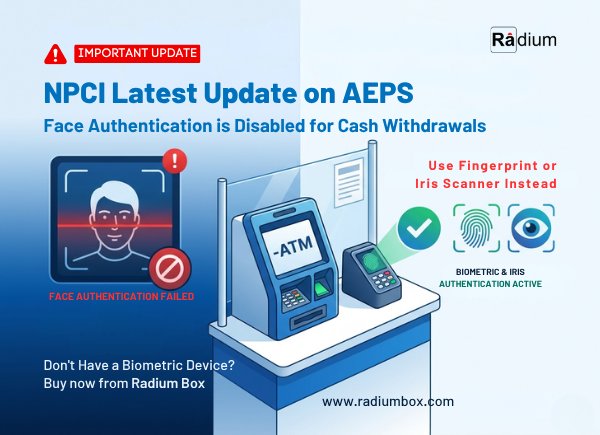
NPCI acted fast. The NPCI latest update on AePS states that face authentication on AePS cash withdrawal and Aadhaar Pay services is officially disabled. This was simply done as a precautionary measure- to protect common users against monetary fraud.
Just imagine it in this way: when one discovered a loophole in the lock of your house, you could not maintain the same lock. You'd change it. This is what NPCI has done in this case.
Also Check NPCI update on user's consent to access the location data on the UPI app.
This is a point that causes confusion to many so here we will be very clear.
Face authentication is NOT gone completely. It has been disabled only in certain high-risk transactions. The following is a bare outline:
|
🚫 Face Authentication — DISABLED
|
✅ Face Authentication — STILL ACTIVE
|
Face authentication still works if you are a banking correspondent or a customer just checking his or her account balance or getting a mini statement. Only the cash withdrawal and Aadhaar Pay features are now in need of a physical biometric device.
This NPCI AePS new rule directly affects your work, in case you are a Business Correspondent (BC) agent and provide AePS services.
You can now no longer able to use a camera-based face scan to process cash withdrawals or Aadhaar Pay transactions. To make these transactions, you will require a certified biometric device, a fingerprint scanner or an iris scanner.
Here's what to do:
Make sure that you already have a registered AePS biometric or iris device.
In case you do not have one, you should immediately buy a certified biometric device.
Complete your AEPS registration with the new device, as required.
Upgrade your application or software (where applicable) in case you are using an AePS app - ensure that you upgrade to the latest version which reflects the NPCI face authentication update.
Inform your customers of this change to avoid confusion on their part when they visit your point.
📌 Where to Get a Biometric Device?In case you do not have a biometric fingerprint device or iris scanner, you can buy certified solutions with authorized dealer from Radium Box, which provide UIDAI-approved biometric devices suitable for AePS transactions. Always make sure that you purchase a certified device that can support Aadhaar-based authentication. |
AePS is handled using an app on their phone by many BC agents and customers. Since the NPCI face authentication update online has become effective, the providers of apps are likely to mirror this.
When using an NPCI face authentication update app, please ensure:
The current version of your app is updated.
Cash withdrawal option with face authentication is either disabled or turned off.
The app is able to connect with your biometric device to make cash transactions correctly.
In case face authentication for cash withdrawal remains on the app as an option, reach out to your service provider. This may be a compliance problem in their part.
Much-needed query - and the brief answer to the same is: no, it does not have any impact on your Aadhaar card itself.
The NPCI face authentication update Aadhaar card change does not impact the manner in which transactions are authenticated. The AePS system is still based on your Aadhaar. As before, your Aadhaar information, such as your fingerprint and face scan, will be kept at UIDAI.
On the same note, when you are asking about NPCI KYC update online or e-KYC online check, there is no disruption of the process of KYC or e-KYC. Aadhaar e-KYC online and the E-KYC update systems overall are functioning as usual. This is an update about the authentication of the transaction of AePS, not your identity documents or KYC status.
As a regular customer, who comes to a BC agent to get money while using Aadhaar card - this is what you should know:
You will now have to always use your fingerprint or iris to withdraw cash.
In case the device that the agent uses cannot read your fingerprint, request them to scan your iris or use another device.
Check status: You can still check your AePS balance check status through face authentication, provided the agent has it enabled.
Do not give up your phone or have another person sign in on your behalf, this is how fraud happens.
The NPCI latest update on AePS Aadhaar is ultimately designed to protect you. Face scans had been abused by fraudsters. The new rule makes your money even more locked up.
📋 Key Takeaways at a Glance
|
As a Business Correspondent agent or a frequent user of AePS services, the right biometric device has never been more important than currently, as NPCI has recently updated its rules to block face authentication when withdrawing cash.
The following are the most reliable and popular biometric devices, which are compatible with AePS transactions.
These are certified and meet the requirements of the NPCI and UIDAI and are safe when it comes to AePS cash withdrawals, Aadhaar Pay, and other biometric transactions.
One can easily imagine this to be an inconvenience. Agents now need a device. Customers can't just look at a camera and get money. But take a step back and see what NPCI is attempting to do.
The whole AePS system was designed to take banking to the last mile in India - to the farmer in the far-flung village, to the daily-wage worker without a smartphone. It is effective as it is trusted. The moment fraud destroys that trust, the entire system will be harmed.
NPCI is ensuring that the integrity of the system is preserved by disabling face authentication in high-risk transactions. Biometric fingerprint or iris scan is far more difficult to counterfeit compared to a photograph or a camera trick. The NPCI AePS new rule is a short term inconvenience to a very important long term goal.
The digital payment system in India is one of the most ambitious globally. This is the reason that updates such as these, even though they may seem disruptive are what make it clean, safe, and trustworthy.
The NPCI face authentication update is active and matters. Whether you're a BC agent or a customer relying on these services, knowing about this change keeps you ahead. The rule is simple: cash withdrawal and Aadhaar Pay now involve a biometric device. Face authentication applies only to non-cash services.
And in case you have not done this yet, you should do so. If you haven't done so, observe a certified device, refresh your app, and communicate with your customers. The system is changing – and we should adapt. Your money deserves the best protection. This update is another step in that direction.
To get a more detailed explanation of how these devices operate and what one may be the most suitable device to fit your needs, take a look at this video: 👉 https://youtu.be/1Kw7Ri-u_H4
To get more information, tips and the most recent updates, follow our channel and keep up with all changes that are important to you.
DISCLAIMER: Details based on NPCI standards For official updates, go to npci.org.in. Make sure to confirm with your service provider.
No, the NPCI face authentication update Aadhaar card change only affects how transactions are verified not your Aadhaar card itself.
The NPCI latest update on AePS means face authentication can no longer be used for cash withdrawals or Aadhaar Pay. You must now use a certified fingerprint scanner or iris device
Yes, you can withdraw cash from the AePS app by using biometric fingerprint or iris device to complete a transaction. Face authentication is no longer accepted for transaction as per the new NPCI AePS new rule.
You can check the latest official guidelines directly on npci.org.in.
NPCI has officially disabled face authentication for AePS cash withdrawals and Aadhaar Pay transactions. This NPCI latest update was rolled out because fraudsters were misusing the face scan feature to make unauthorised cash withdrawals. To protect users, NPCI now requires a physical biometric or iris device for these transactions.



 0
0

